Psychology & Neurodiversity
social.group.members
From human behaviour to neurodiverse perspectives, explore how we think, feel, and experience the world 🧠

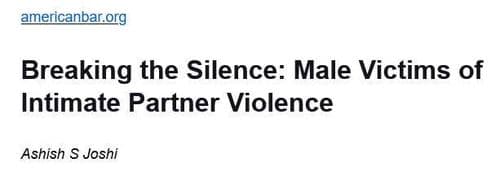
American lawyer Ashish S. Joshi developed this analysis based on numerous scientific studies showing that domestic violence is not specific to men and cannot be explained solely on the basis of gender or gender roles.
Furthermore, he presents data on how women exploit current stereotypes and propaganda about domestic violence to their advantage in the justice system, despite research showing that only 6% of these reports are confirmed as domestic violence during court proceedings.
As a practicing lawyer, he highlights the enormous prejudice against men and the consequences of systemic discrimination on their finances, health, and psychological and emotional well-being.
"Despite extensive documentation of male victimization, little research has examined and reported on men’s experiences of abuse in intimate relationships. This gap exists partly because the dominant paradigm in IPV research suggests that men systematically and intentionally use violence to maintain a power system in which men are dominant and women are subordinate. This perspective—reinforced by stereotypes, groupthink, and deeply entrenched belief systems—views IPV perpetrators as exclusively or disproportionately male
In another study, Professor Alexandra Lysova—who has studied IPV, including violence against women and children, for over 20 years in Russia and Canada—reported that men’s victimization can take the form of physical and sexual violence, psychological aggression, financial abuse, legal and administrative abuse, and homicide. In fact, in Western industrialized countries, one-third to one-half of all IPV victims are men.
Researchers at the Centers for Disease Control and Prevention have revealed staggering numbers: More than 40 percent (44.2 percent, or 52.1 million) of U.S. men reported some kind of sexual violence, physical violence, or stalking (or a combination of these) by an intimate partner in their lifetime. These men reported rape, being made to penetrate, sexual coercion, slapping, pushing, being hit with objects, kicked, slammed against surfaces, hair pulling, and beatings.
In research conducted by social scientists Denise A. Hines and Emily M. Douglas, over half of the men reported that their women partners made false accusations against them, such as that he hit or beat her, that a restraining order was filed against him under false pretenses, or that he physically or sexually abused the children or even physically and sexually abused them. The researchers found that these findings are also consistent with a study of families undergoing custody disputes in the courts, which showed that 21 percent of women made allegations of physical child abuse against their husbands, 23 percent made allegations of sexual child abuse, and 55 percent made allegations of IPV. Only 6 percent, 6 percent, and 41 percent of the accusations, respectively, were substantiated by the courts.
Male victims report their experiences on crime victim surveys less frequently than female victims, thereby creating a false impression of the scope of the problem. This underreporting stems from multiple systemic failures: Men are less likely to be believed by law enforcement, less likely to be taken seriously, and more likely to be accused of perpetrating the violence they are reporting. This consistent pattern of dismissal of men victims is found not just in the United States but internationally, in Western industrialized countries. In the Netherlands, men do not report the abuse to law enforcement, believing that law enforcement would not act on the report. In the United Kingdom, male victims of women perpetrators are more often ignored by the police. Australian police have told male victims to “grow some balls.”
More in link: https://www.americanbar.org/groups/litigation/resources/litigation-journal/2026-winter/male-victims-intimate-partner-violence/

The Muzz Syndrome:
When a girl makes an account, gets flooded with requests, and decides to talk to all of them at once. She gets overly picky, starts bragging about her options to every new match, and then wonders why she’s crying herself to sleep at night asking why she’s still alone.
The illusion of endless choice is ruining genuine connection.

The real neurodivergent experience is being told you’re overthinking by people who communicate entirely through implication.

Nobody talks about this. But the data, the psychology, and honestly my own experience all say the same thing.
We are the most connected generation in human history.
And somehow, the loneliest.
The numbers first:
78% of dating app users report emotional exhaustion. 84% have been ghosted. 1.4 million people abandoned dating apps in the UK alone between 2023 and 2024.
We have more options than any generation before us.
And less genuine connection than almost any of them.
Now the psychology:
Research shows that the human nervous system doesn't seek what's good for you. It seeks what's familiar.
If love in your formative years felt inconsistent you will unconsciously chase inconsistency as an adult and call it passion.
If the people who were supposed to show up for you didn't you will spend years trying to finally "earn" presence from people who were never going to give it.
This is called repetition compulsion. And it runs deeper than logic, deeper than awareness, deeper than "I know better."
You can know someone is wrong for you. See every sign clearly. And still stay because leaving feels more dangerous than the dysfunction you already understand.
Now the part nobody wants to admit:
Most people on dating apps aren't looking for someone.
They're looking for proof.
Proof that they're attractive enough. Interesting enough. Worthy enough.
The match is dopamine. The conversation is a test. The ghost is a verdict.
And we keep swiping not to find someone but to finally feel like enough.
And personally
I've been on this app for a month. I write about human psychology. I'm about to start my MBA at IIM. I create content. I write poetry and music.
And I still sat with the same quiet question everyone here sits with at some point
Am I the problem?
Maybe. Partially. We're all the problem partially.
But here's what I've slowly understood
The right person won't find you when you're performing.
They'll find you when you're finally tired of performing.
When you stop optimizing your bio and start being honest in it. When you stop crafting the perfect opener and start saying what you actually mean. When you stop looking for someone impressive and start looking for someone real.
The question I'll leave you with
Are you on this app looking for someone?
Or are you on this app looking for proof that you're worth looking for?
Because those are two very different searches.
And only one of them leads somewhere real.
If you ever studied psychology you know a LOT of accusations are actually confessions…

✅✅
You deserve to be in environments that bring out the softness in you, not the survival in you.


The halo effect ?
What are your eyes visually drawn to first in this photograph ? 👀

𝗛𝗮𝗿𝘀𝗵 𝗿𝗲𝗮𝗹𝗶𝘁𝘆 𝗼𝗳 𝘁𝗼𝗱𝗮𝘆’𝘀 𝘀𝗼𝗰𝗶𝗲𝘁𝘆:
It’s sad watching so many modern women turn away the men who would’ve made them great wives, only to run towards the men who leave them as single mothers. Choosing temporary excitement over stability and foundation.
Then, when the games end, the same question appears: “𝗪𝗵𝗲𝗿𝗲 𝗮𝗿𝗲 𝘁𝗵𝗲 𝗴𝗼𝗼𝗱 𝗺𝗲𝗻?”
The truth is, you sent them away for thrill, for attention, for men who never planned to build anything lasting — only to use you like a tissue paper and then leave.
Good men don’t chase games. They focus on building legacies, and they don’t wait forever.

