Islam
social.group.members
🕋 Spirituality, hadiths, Islamic history and teachings. Connect with fellow members in enlightening conversations as we seek a deeper understanding and appreciation of Islam.
A Miracle at the Prophet’s Mosque.
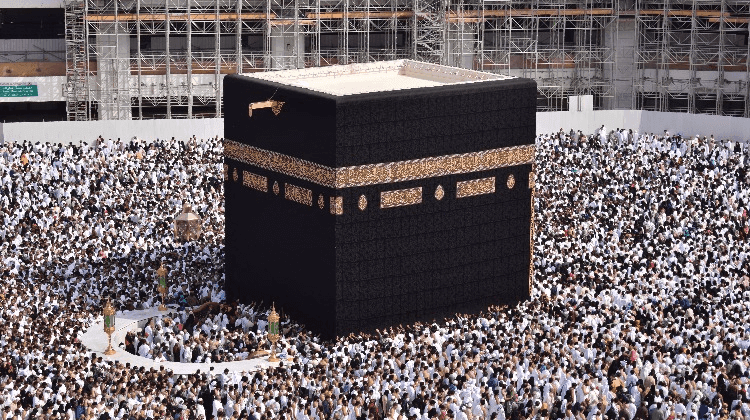
When the decision was made to install the same radiant white marble on the floor of Masjid an-Nabawi (PBUH) that had graced the floors of Masjid al-Haram, a profound miracle unfolded.
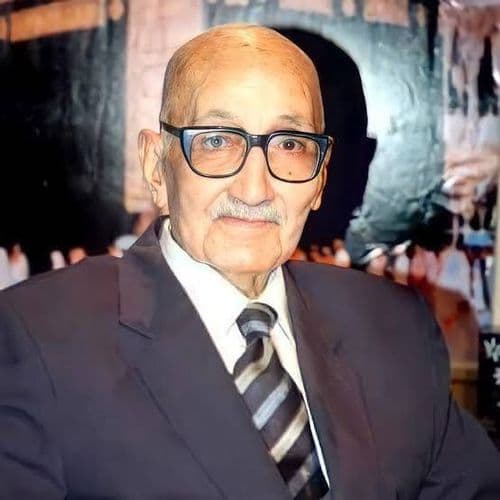
Muhammad Kamal Ismail was the first engineer entrusted with the monumental task of designing and executing the expansion projects of the Two Holy Mosques. Despite repeated insistence from King Fahd, he refused to accept any remuneration for his engineering designs and architectural supervision. He would say, "Why should I take payment for this work? How will I face Allah on the Day of Judgment?"
He married at the age of 44. His wife gave birth to a son but passed away shortly after. From that time until his death, he remained devoted to the worship of Allah. He lived to the age of one hundred, yet shunned worldly fame and media attention, serving the Two Holy Mosques in quiet anonymity.
The story of how he acquired the special white marble for the Haram is itself deeply moving. This unique stone, which beautifully absorbs heat and keeps the floors cool even in the scorching heat, was found in a small mountain in Greece. Engineer Kamal traveled there and signed an agreement to purchase nearly half the mountain. After the deal was finalized, he returned to Makkah. The marble arrived and was successfully installed in Masjid al-Haram, adorning both the Mataf (the area around the Ka'bah) and the outer courtyards.
Fifteen years later, the Saudi government decided to use the same marble for the flooring of Masjid an-Nabawi. When King Fahd instructed Engineer Muhammad Kamal to source the identical marble, he became deeply worried. The only place on earth where this stone existed was Greece, and they had already purchased half the mountain.
Kamal returned to Greece and met the CEO of the same company. When he inquired about the remaining marble, the CEO replied, "We sold it shortly after you left. It has been fifteen years now."
Heartbroken, Kamal stood up to leave the meeting. As he was departing, he met the office secretary and asked if she could help trace the buyer of the remaining marble. She told him it would be difficult to find old records but requested his phone number and hotel details, promising to try. He gave her the information and left, planning to return the next day.
Before leaving the office, Kamal thought to himself: "What need do I have to search for the buyer? Allah Himself will make arrangements."
The very next day, just hours before his flight, he received a call: the address of the marble buyer had been found. Kamal made his way back to the office, his heart heavy with anticipation. When the secretary handed him the company details, his heart skipped a beat. He took a deep breath in awe.
The company that had purchased the marble was Saudi.
Kamal immediately boarded a flight to Saudi Arabia. He went straight to the company’s office and met the Director of Administration. When he asked what had become of the white marble imported from Greece, the director said he didn't recall and called the stock department. The reply came: "The entire quantity is still here. It has never been used."
At that moment, Engineer Kamal wept like a child. He narrated the entire story to the company's Saudi owner and presented him with a blank cheque.
"Fill in any amount you wish," he said, "but please hand over all the marble to me."
When the Saudi owner learned that this marble was destined for Masjid an-Nabawi, he refused to take even a single riyal.
He said with deep emotion, "Allah had this marble purchased through me, and then made me forget about it. It is clear that this marble was always meant for the Prophet’s Mosque (PBUH)."
SubhanAllah.
A beautiful reminder of how Allah orchestrates even the smallest details for His beloved places and His sincere servants.
I carry dreams in one hand,
And tawakkul in the other.
The world teaches us to chase,
But faith teaches us to trust.
So I walk gently through life,
Guarding my heart,
Improving my character,
And leaving the rest to Allah.
If our stories are destined to meet,
They will meet beautifully—
Not by force,
Not by chance,
But by the perfect decree of the One who writes every chapter. ✨🌙🤍
🌹 As-Salamu Alaikum wa Rahmatullahi wa Barakatuh.
Begin this morning by renewing your faith and trust in Allah. May He guide our steps, protect our families, and bless our efforts today. Ameen. 🤲
🗣️🗣️Follow the Islamic version of Prophet Adam, Islam is his religion. But why is the phrase Islam more well-known during the time of Prophet Muhammad (peace and blessings of Allah be upon him). Even the Al-Kahfi scenario was indeed to be presented during the time of Prophet Muhammad, but the incident of the 7 sleeping youths occurred in the time after Prophet Jesus was raised to heaven. And Allah destined Jacob of Sarug to immortalize the incident in his book. And the book is famous for being used for sermons in churches. That era was long before Islam appeared. When Islam appeared, the infidels of Quraysh looked for a loophole to deny the prophethood of Prophet Muhammad by asking questions about the incident of the sleeping youths in the cave.
In Islamic belief, Islam is the universal and eternal religion of all Prophets from Adam to Muhammad. It is more well-known during Prophet Muhammad's era because his prophethood marked the completion of Allah's divine message and the codification of its final, preserved form, uniting the original teachings of all previous messengers.
The scenario of the youths in Surah Al-Kahf is deeply tied to the historical and theological timeline you mentioned, which also explains why the Quraysh used it as a test:
Why the Phrase "Islam" Became Prominent
The Universal Message: In the Quran, the foundational definition of Islam is simply submission and devotion to the will of the One True God.
Prophetic Succession: From an Islamic perspective, Prophet Adam and all succeeding prophets (including Jesus) brought the same core message of (Tawhid) (monotheism). However, the specific practices, rituals, and comprehensive laws of the faith were updated and finalized with Prophet Muhammad, who was sent as the final messenger to all of humanity.
The Al-Kahf / Seven Sleepers Scenario
The Historical Incident: The historical narrative of the Seven Sleepers (who fled into a cave to protect their monotheistic faith) occurred in the post-Jesus era, often associated with the persecutions of the Roman Emperor Decius and their subsequent awakening during the reign of Christian Emperor Theodosius II.
Jacob of Sarug’s Role: Jacob of Sarug (a prominent 5th-century Syriac bishop and poet) indeed helped popularize and immortalize this miraculous story through his written homilies (memre), which became deeply influential in Eastern Christian traditions.
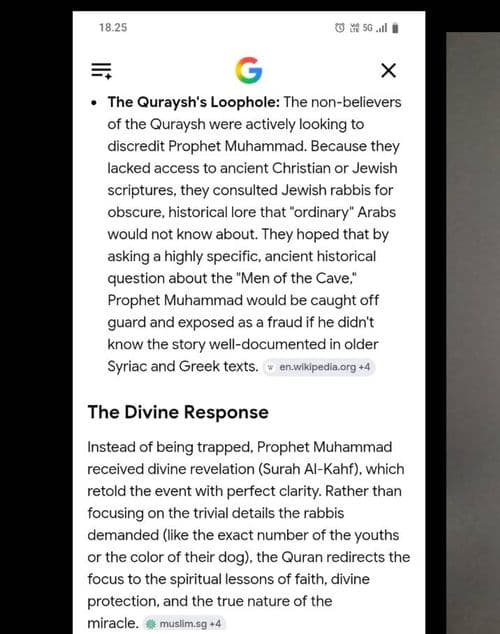
The Quraysh's Loophole: The non-believers of the Quraysh were actively looking to discredit Prophet Muhammad. Because they lacked access to ancient Christian or Jewish scriptures, they consulted Jewish rabbis for obscure, historical lore that "ordinary" Arabs would not know about. They hoped that by asking a highly specific, ancient historical question about the "Men of the Cave," Prophet Muhammad would be caught off guard and exposed as a fraud if he didn't know the story well-documented in older Syriac and Greek texts.
The Divine Response
Instead of being trapped, Prophet Muhammad received divine revelation (Surah Al-Kahf), which retold the event with perfect clarity. Rather than focusing on the trivial details the rabbis demanded (like the exact number of the youths or the color of their dog), the Quran redirects the focus to the spiritual lessons of faith, divine protection, and the true nature of the miracle.
24 Dhul Hijjah 1447
10 June 2026
Wednesday يوم الأربعاء
Rasulu Llah ﷺ mentioned in a sermon he delivered during the days of Hajj:
“O People! Certainly your Rabb is one, your father is one. An Arab has no virtue over a Non Arab, nor does a Non Arab have virtue over an Arab, a red skinned person is not more virtuous than a dark skinned person nor is a dark skinned person more virtuous than a red skinned person except through Taqwa.”
(Musnad Ahmad, vol. 5 pg. 411)
To all the fathers around the world